Showing posts with label psychoanalytic. Show all posts

Wednesday, July 4, 2018

Mark Winborn Featured on Speaking of Jung Podcast

Speaking of Jung Podcast - Posted on July 2, 2018 (Click Here to Listen)

This is Dr. Winborn's second interview on the Speaking of Jung Podcast hosted by Laura London. The focus is on his forthcoming (Routledge, Aug. 8, 2018) book Interpretation in Jungian Analysis: Art and Technique.


Analytic interpretation is fundamental to the process of psychoanalysis, Jungian analysis, and psychoanalytic psychotherapy. Interpretation is the medium by which the psychoanalytic art form is transmitted. What one chooses to say in analysis, why one chooses it, how one says it, when one says it; these are the building blocks of the interpretive process and the focus of Interpretation in Jungian Analysis: Art and Technique.
This volume is the first of its kind in the literature of analytical psychology. Until now, the process of interpretation has been addressed only briefly in general Jungian texts. Interpretation in Jungian Analysis provides an in-depth exploration of the process, including the history of analytic technique, the role of language in analytic therapy, the poetics and metaphor of interpretation, and the relationship between interpretation and the analytic attitude. In addition, the steps involved with the creation of clear, meaningful, and transformative interpretations are plainly outlined. Throughout the book, clinical examples and reader exercises are provided to deepen the learning experience. The influence of the Jungian perspective on the interpretative process is outlined, as are the use of analytic reverie and confrontation during the analytic process.

In addition to the historical, technical, and theoretic aspects of interpretation, this book also focuses on the artistic and creative elements that are often overlooked in the interpretive process. Ultimately, cultivating fluidity within the interpretive process is essential to engaging the depth and complexity of the psyche. Interpretation in Jungian Analysis will be of great interest to psychoanalysts and psychotherapists of all theoretical orientations and will be essential reading for students of analytical psychology.
Mark Winborn, PhD is a clinical psychologist and Jungian analyst in private practice in Memphis, Tennessee.

He received a Bachelor of Science in psychology from Michigan State University in 1982, a Master of Science and Ph.D. in clinical psychology from the University of Memphis in 1987, and a certificate in Jungian Analysis from the Inter-Regional Society of Jungian Analysts in 1999.


Dr. Winborn served for three years as the staff psychologist for the United States Military Academy in West Point, New York and is now a training and supervising analyst at the C.G. Jung Institute Zürich and for the Inter-Regional Society of Jungian Analysts in North America. He currently serves on the American Board for Accreditation in Psychoanalysis, and the Ethics Committee of the International Association for Analytical Psychology. Dr. Winborn is on the editorial boards of the Journal of Analytical Psychology and the Journal of Humanistic Psychology, and is a member of the National Association for the Advancement of Psychoanalysis.

He has presented papers at the past three Congresses of the International Association for Analytical Psychology (Montreal 2010, Copenhagen 2013, Kyoto 2016), and will present again at the Vienna Congress in 2019. Since 1990 he has maintained a private practice in Memphis, Tennessee where he was the Training Coordinator for the Memphis Jungian Seminar from 2010 - 2016. In addition to his teaching activities in Memphis and Zürich, he has been an invited presenter for Jungian societies, training seminars, and institutes throughout the United States, as well as in Russia and the Dominican Republic.

He is the author of Deep Blues: Human Soundscapes for the Archetypal Journey, published in 2011, and is the editor of the book, Shared Realities: Participation Mystique & Beyond, published in 2014. His new book, Interpretation in Jungian Analysis: Art & Technique, will be released on August 8th of this year, and is the subject of our talk today.

This interview was recorded on Sunday, July 1, 2018. It's 57:51 long and 25 MB. You can listen to it right here in your browser or download it directly to your computer. This episode is also available on iTunes, Stitcher, Google Play, or wherever you get your shows.

Sunday, April 15, 2018

A New Interview with Mark Winborn by Stefano Carpani

A new interview with Mark Winborn, Jungian psychoanalyst, by Stefano Carpani in the library of the C.G. Jung Institute in Zurich, Switzerland. The interview took place February 2018. It covers the publication of Dr. Winborn's new book Interpretation in Jungian Analysis, what becoming a psychoanalyst means, the nature of the analytic process, comparative psychoanalysis, and cultivating the analytic attitude.
YouTube Link


Thursday, March 8, 2018

Interpretation in Jungian Analysis: Art and Technique


Pre-publication announcement (arriving July 2018, Routledge) "Interpretation in Jungian Analysis: Art and Technique" by Mark Winborn. This volume is the first of its kind in the literature of analytical psychology. Until now, the process of interpretation has been addressed only briefly in general Jungian texts. Interpretation in Jungian Analysis provides an in-depth exploration of the process, including the history of analytic technique, the role of language in analytic therapy, the poetics and metaphor of interpretation, and the relationship between interpretation and the analytic attitude. In addition, the steps involved with the creation of clear, meaningful, and transformative interpretations are plainly outlined.


Analytic interpretation is fundamental to the process of psychoanalysis, Jungian analysis, and psychoanalytic psychotherapy. Interpretation is the medium by which the psychoanalytic art form is transmitted. What one chooses to say in analysis, why one chooses it, how one says it, when one says it; these are the building blocks of the interpretive process and the focus of Interpretation in Jungian Analysis: Art and Technique.

In addition to the historical, technical, and theoretic aspects of interpretation, this book also focuses on the artistic and creative elements that are often overlooked in the interpretive process. Ultimately, cultivating fluidity within the interpretive process is essential to engaging the depth and complexity of the psyche. Interpretation in Jungian Analysis will be of great interest to psychoanalysts and psychotherapists of all theoretical orientations and will be essential reading for students of analytical psychology.

Saturday, January 13, 2018

Mark Winborn presenting 5 week seminar "The Fundamentals of Technique in Analytic Therapy" to Moscow Assoc. for Analytical Psychology

The Psychoanalytic Muse editor, Mark Winborn, is honored to be invited to teach a 5 week - 16 hour webinar on "The Fundamentals of Technique in Analytic Therapy" for the Moscow Association for Analytical Psychology. Beginning Jan 13th - the seminar covers the history of technique, the analytic attitude, the structure of analytic therapy, roles in analysis, analytic interpretation, beginning an analysis, defenses, resistance, transference/countertransference analysis, unconscious communication, and termination. http://www.maap.pro/

Sunday, September 10, 2017

Re-Encountering Jung: Analytical psychology and contemporary psychoanalysis

Available Now Click on this to Order from Routledge
Psychoanalytic Muse editor Mark Winborn contributes a chapter Bion and Jung: Intersecting Vertices.
Since the split between Freud and Jung, psychoanalysis and analytical psychology have largely developed in an atmosphere of mutual disregard. Only in recent years have both discourses shown signs of an increasing willingness to engage. Re-Encountering Jung: Analytical Psychology and Contemporary Psychoanalysis is the first edited collection of papers devoted to a reconciliation between these two fields. The contributors explore how Jungian thinking influences, challenges, and is challenged by recent developments in the psychoanalytic mainstream. In examining the nature of the split, figures from both sides of the conversation seek to establish lines of contrast and commonality so as to reflect an underlying belief in the value of reciprocal engagement.
Each of the chapters in this collection engages the relationship between Jungian and psychoanalytic thinking with the intention of showing how both lines of discourse might have something to gain from attending more to the voice of the other. While several of the contributing authors offer new perceptions on historical concerns, the main thrust of the collection is in exploring contemporary debates.


Re-Encountering Jung reflects a unique undertaking to address one of the longest-standing and most significant rifts in the history of depth psychology. It will be of great interest to all academics, students and practitioners within the fields of analytical psychology and psychoanalysis.


Thursday, August 24, 2017

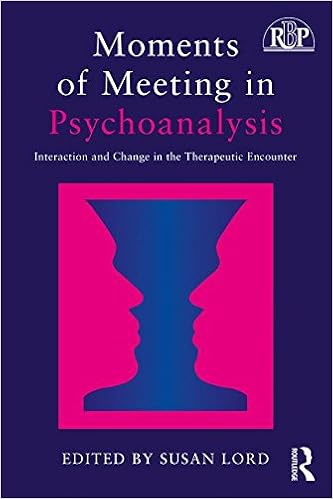
Moments of Meeting in Psychoanalysis - Book Publication

Announcing the publication of "Moments of Meeting in Psychoanalysis: Interaction and Change in the Therapeutic Encounter" edited by Susan Lord and published by Routledge. Psychoanalytic Muse Editor Mark Winborn contributes a chapter titled "The Aesthetics of Being." The other contributors include a wide range of psychoanalysts, Jungian analysts, and psychoanalytic psychotherapists. Order at Amazon


There are moments of connection between analysts and patients during any therapeutic encounter upon which the therapy can turn. Moments of Meeting in Psychoanalysis explores how analysts and therapists can experience these moments of meeting; shows how this interaction can become an enlivening and creative process; and seeks to recognise how it can change both the analyst and patient in profound and fundamental ways.
The theory and practice of contemporary psychoanalysis and psychoanalytic psychotherapy has reached an exciting new moment of generous and generative interaction. As psychoanalysts become more intersubjective and relational in their work, it becomes increasingly critical that they develop approaches that have the capacity to harness and understand powerful moments of meeting, capable of propelling change through the therapeutic relationship. Often these are surprising human moments in which both client and clinician are moved and transformed. Moments of Meeting in Psychoanalysis offers a window into the ways in which some of today’s practitioners think about, encourage, and work with these moments of meeting in their practices. Each chapter of the book offers theoretical material, case examples, and a discussion of various therapists’ reflections on and experiences with these moments of meeting.
With contributions from relational psychoanalysts, psychotherapists and Jungian analysts, and covering essential topics such as shame, impasse, mindfulness, and group work, this book provides new theoretical thinking and practical clinical guidance on how best to work with moments of meeting in any relationally oriented therapeutic practice. Moments of Meeting in Psychoanalysis will be of great interest to psychoanalysts, psychoanalytic psychotherapists, psychologists, social workers, workers in other mental health fields, graduate students, and anyone interested in change processes.

Sunday, June 4, 2017

Forthcoming Teaching and Speaking Schedule June 2017- April 2018 for Mark Winborn, PhD, NCPsyA

June 11, 2017: Moscow Association for Analytical Psychology, Moscow, Russia
                                
Sept 1-3, 2017: Centro Jung, Santo Domingo, Dominican Republic

Sept 23-24, 2017: Memphis-Atlanta Jungian Seminar, Memphis, Tennessee

Oct 14-15, 2017: Minneapolis Jung Association, Minneapolis, Minnesota

Nov 3-5, 2017: Case Colloquia, Philadelphia Assoc. of Jungian Analysts, Philadelphia, Pennsylvania

Nov 17, 2017: American Board for Accreditation in Psychoanalysis, New York, New York

Dec 1-2, 2017: Jung Association of Central Ohio, Columbus, Ohio

Jan 26-28, 2018: Case Colloquia, Philadelphia Assoc. of Jungian Analysts, Philadelphia, Pennsylvania

Feb 11-18, 2018: C.G. Jung Institute, Zurich/Küsnacht, Switzerland

Mar 2-4, 2018: Case Colloquia, Philadelphia Assoc. of Jungian Analysts, Philadelphia, Pennsylvania

Apr 16-17, 2018: Case Colloquia, Philadelphia Assoc. of Jungian Analysts, in Santa Fe, New Mexico

Thursday, May 25, 2017

Analytical Psychology and Science: Adversaries or Allies? by Mark Winborn, PhD, NCPsyA

In Psychological Perspectives, 2016, Vol. 59, #4, pp. 490-508


Conclusion:

Jung (like Freud) saw himself as a scientist and was constantly incorporating new ideas from other fields such as linguistics, anthropology, physics, Gnosticism, and alchemy.  In fact, Jung has been referred to as a bricoler - a French word that refers to someone who pieces things together from a variety of sources.  I believe Jung, if he were alive today, would have embraced the recent findings from infant observation, neurosciences, attachment research, and trauma research just as he did with Fordham’s early forays into child analysis.  I would challenge us to consider whether we want to suspend progress in Analytical Psychology, preserving it in the “just so” state we’ve become comfortable with.

I believe our task as Jungians is to re-evaluate, re-cast, re-interpret Jung’s ideas in light of knowledge from other fields – just as Jung did in developing his conceptual framework originally. But we have to be in dialogue with other fields and have an understanding of their findings in order for this to occur. I believe we have a responsibility to the scientific method which shaped and informed Jung’s inquiries; a responsibility to peer more deeply into the relationship between brain and mind and between soma and psyche; into the psychological and neurological underpinnings of conscious and unconscious processes; to seriously evaluate Jung's typological model in light of current neurological and cognitive sciences; and inform our candidates about the current theoretical debate occurring between those holding apriori positions on the nature of archetypal experience and those who now postulate archetypal experience as  emergent phenomena.  

Ultimately, scientific empiricism can’t study or evaluate all of the elements of Analytical Psychology. Many elements of our field can’t be sufficiently operationally defined in a manner that would allow study through the scientific vertex. But there are many elements of Analytical Psychology which can be examined through a scientific lens - a process by which we can deepen our confidence in our methods and theories, gain a deeper understanding of why certain methods work, and occasionally a casting off or remaking of certain theories or practices which can’t be supported from a scientific perspective. We can’t afford to cast off empiricism out of a preference for subjectivism if Analytical Psychology is to survive another 100 years as something other than a well preserved museum piece.
Many fields of scientific inquiry have moved towards the positions advocated by Jung while at the same time adding many new insights it wasn’t possible for Jung to imagine despite his incredible breadth of vision. We do have Jungians among us who are engaged with the scientific community. There are a small cadre of others trying to bring Analytical Psychology into dialogue with contemporary science, including Mario Jacoby, George Hogenson, Joseph Cambray, Jean Knox, Margaret Wilkinson, John Merchant, Robert Romanyshyn, David Rosen, Christian Roesler, and John Haule.

In order for this shift to happen, some who come from backgrounds in the arts and humanities may need to learn something about the scientific method including research design, sample size, types of validity and reliability, as well as some familiarity with statistical inference. But this is not unlike my own journey - coming from a scientist-practitioner model of clinical psychology training and needing to become more intimately familiar with the metaphoric world of myths, fairytales, art, poetry, literature, and religion.

I hope this paper leaves you with the impression that Analytical Psychology and science can be and need to be allies rather than adversaries. We need the findings from contemporary science to help us reflect on what we experience as analytic practitioners. Science needs us to advocate for the subjective element in the laboratory. Be we cannot fulfill Jung’s dream of a Analytical Psychology as a mediatory science unless we are in an ongoing dialogue with the scientific community. In closing, I leave the reader with this thought from Carl Jung (1976, para. 1236) “Ultimate truth, if there be such a thing, demands the concert of many voices.” 

Friday, November 27, 2015

James Grotstein on The Transcendent Position

BION'S "TRANSFORMATION IN 'O'" AND
THE CONCEPT OF THE "TRANSCENDENT POSITION" 
by James S. Grotstein

INTRODUCTION

Bion, who was to become the awesome explorer of the "deep and formless infinite" of the psyche, first immersed himself in the theories of Freud and Klein and then gradually developed a revolutionary metapsychological metatheory for psychoanalysis. Bion incurred the criticism of his colleagues by daring to investigate faith, spirituality, religion, mysticism, metaphysics, and fetal mental life. His concepts of transformations in L(ove), H(ate), and K(nowledge), as well as of intuitionistic and subjective science [Transformations in "O" (Ultimate Truth, Absolute Reality)], constitute an objective and numinous psychoanalytic epistemology.

Bion was preoccupied with the concept of ultimate reality and absolute truth and reoriented psychoanalytic metapsychology into a theory of thinking and meta-thinking about emotions. He distinguished the "thoughts-without-a-thinker" from the mind that had to develop in order to think them. I believe that his concept of "intuitionistic thinking" also presumes the presence of a more profound aspect of that mind: Not only did a mind develop to harvest the "thoughts without a thinker," but another aspect of the mind had to originate these "unthought thoughts." I believe that Bion came to a realization that true "thinking" ("dream work alpha" along the dimensions of "L, H, and K") is an unconscious -- if not preconscious -- act and that what we normally term "thinking" (application of the ordinate and abscissa of the "Grid") is really "after-thinking."

By realigning psychoanalysis with metaphysics and ontology (existentialism), Bion perforated the mystique of ontic "objectivity" implicit to logical-positivistic, deterministic science and revealed its own unsuspected mythology--its absolute dependence on sense data. Applying his concept of reversible perspective, he found myths, both collective and personal, to be themselves "scientific deductive systems" in their own right (Bion, 1992). Mostly, Bion founded a new mystical science of psychoanalysis, a numinous discipline based on the abandonment of memory, desire, and understanding. To Bion, mysticism is "seeing things as they truly are -- without disguise" (personal communication). He was preoccupied with the question of how we know what we know.


In this contribution I emphasize my understanding of Bion as the intuitionistic epistemologist, the "emotional mathematician" (Bion, 1965), the "mystical scientist" (Bion, 1970), the intrepid voyager into the deep and formless infinite, "O." I suggest that a "Transcendent Position" is implied by Bion's conception of "O," the latter of which overarches "nameless dread," beta elements, the "thing-in-themselves," the noumenon, "absolute truth," "ultimate reality," and "reverence and awe." 

Friday, October 30, 2015

Curator of The Psychoanalytic Muse Interviewed by "Speaking of Jung"

Dr. Mark Winborn at Bollingen, the lake
retreat of C.G. Jung in Switzerland
Dr. Mark Winborn was recently interviewed by Laura London of the “Speaking of Jung Podcast.” The interview has been uploaded to her website and can be listened to or downloaded here:
It’s 55 minutes long and revolves around the general theme of “What is Jungian Analysis?” but it covers a wide territory contrasting Jungian with psychoanalytic perspectives, medications, treatment effectiveness, the therapeutic relationship, choosing an analyst, etc.

Saturday, May 2, 2015

Mark Winborn - Aesthetic Experience and Analytic Process

"We each have an aesthetic sensibility that is collectively influenced, archetypally potentiated, and intimately connected to our individual subjectivity. When conducting an analysis, we implicitly evaluate almost every element on an aesthetic level. Our analytic aesthetics, which are strongly influenced by the culture of our training, significantly impact our sense of what analysis should feel, sound, and look like. Our theoretical orientations are likely adopted because a particular set of theories conform to an internal aesthetic ideal or provide a sense of aesthetic satisfaction. All analysts have aims and ideals in analysis, even these are implicitly held (Sandler & Dreher, 1996). I would extend this idea by saying that all analysts have an aesthetic sense they are working from and responding to, even if they are unaware of it.

Analysis is a work, both active and receptive, in which there is a creative product contributed to by both parties. Therapeutically, we could say analysis is a restoration of an aesthetic response to life in which meaning plays an important organizing role. Attention to the aesthetic elements of analysis brings the interaction alive, awakening our psyches and stirring our imaginations. Aesthetics is a way to give ourselves over to experience – a way of entering into experience, rather than thinking about experience. Hopefully, these sensitivities become something that complement our other ways of ‘being with’ in analysis, rather than becoming one pole of a dichotomized set of opposites where one mode of working analytically is inevitably seen as better than another mode. There must be a moving back and forth between understanding and knowing, which are related to meaning, and a creative response to the analytic situation which is the aesthetic element. In the end, the process of meaning making is itself an aesthetic object rather than a process unto itself." (p. 104)

Mark Winborn - Aesthetic Experience and Analytic Process, International Journal of Jungian Studies, 2015, Vol. 7, #2, pp. 94-107.

Monday, March 9, 2015

Lina Balestriere - Working in the Field of Psychosis

Psychosis questions the very foundations of the concepts on which analysts rely to represent psychic functioning. More than any other pathology, it undermines the pillars of analytical thinking, reveals the intimate core of conceptual thought, dismantles the shared scaffolding of theoretical construction and questions ultimate convictions about the foundations and functioning of the psychic apparatus. What becomes of representation if it disintegrates, becomes a thing, or indeed an empty sound? What becomes of the trace if emptiness, nothingness, paralysis, blankness occupy such a large place in the psychic life of the subject? And then what becomes of a subject or, in Freudian terms, an ego when not only that sense of identity but also more fundamentally that sense of existing, in a relationship, in relation to others, fi rmly grounded on land, which upholds all people, is simply not sustainable? What becomes of anxiety if it reaches the borders of non-existence, if the annihilation process deforms perception, of one’s body, oneself, of others? What then of the encounter, what of the transference, that major process, the decisive lever for psychoanalytic work, at once repetition and a possible exit from repetition, if that encounter perpetually takes place beneath the sword of Damocles, of the inescapable, of powerlessness, annihilation, of that which never happened, or happened too often, of uncontrollable anxiety or persecutory emptiness? To advance into these zones with the concepts we make our own leaves us anxious and distraught. We fear then that these, our beams of light amidst obscurity, to cite a Freudian metaphor, will lose substance before such radical questioning. Once divested of their robes, of their elaborate scaffolding, what will remain? The vertigo of doubt is inescapable. After all, there is no guarantee they have their own existence, in the sense that their relevance might hold for that core of the real which conceptual abstraction attempts to capture. It is undoubtedly not fortuitous that for a long time analysts, and Freud fi rst and foremost, cast doubt upon the psychotic’s capacity for transference. The young science had to preserve itself from too radical a questioning. It was no doubt easier to think the psychotic incapable of transference than to have to submit to the risk of doubt and so risk ruining those convictions acquired in the field of the neuroses.

Nor is it fortuitous that a theory of the psychoses nearly always introduces new concepts: I am thinking of Aulagnier’s pictogram, of Bion’s β-elements, of Lacan’s foreclusion of the Name-of-the-Father, to cite only those theorizations which find a new currency for the problematics of representation. But the force of those theories spares no psychoanalyst confronted with psychosis from asking the essential question. What remains when the building totters and cracks, what of the living core that resists and has our conviction prevail, the raw material, grain of sand from the real, around which can coalesce the pearl of the concept? There is no set answer. Things come to light in singular fashion, for each practitioner, thanks to salutary, vertiginous experience and the collapse of certainties. (pp. 407-408)

Lina Balestriere (2007): The Work of the Analyst in the Field of Psychosis, International Journal of Psycho-Analysis, Vol. 88, pp. 407-421.

Wednesday, February 25, 2015

Michael Diamond - Use of the Analytic Mind and Interpsychic Communication

Conclusion to the Paper: The analyst’s unique use of mind placed in the service of the patient’s mind–body expression provides the driving force for patients to become more able to access their own unconscious mental functioning, both to understand themselves better and to internalize the mutative facets of the relationship with the analyst. Accordingly, the patient’s development is essentially dependent on the analyst’s use of this function and disturbed by perturbations in it. Consequently, as Loewald (1960) advocated, the analyst must offer a more or less evolved representational level, moving a step beyond the patient’s mental state by offering a different yet experientially appropriate perspective of a new, more “mature” object at a higher level of psychic integration. This requires discipline and faith in interpsychic dialogue in the context of an open, emotionally engaged unconscious participation in the analytic dyad.

In order to access and trust the unconsciously functioning analytic instrument, to secure analytic technique, and to better meet the challenges of our “impossible profession” (Freud 1923) by furthering dialogue among different psychoanalytic cultures—particularly given the somewhat neglected primacy of the Freudian unconscious—analysts are best sustained by maintaining confidence in analysis and its potential usefulness for each unique analytic dyad. Therefore, analysts need to recognize the significance of unconscious communication and to possess a clinical perspective grounded in theory both of unconscious mind and of analytic mind use in order to feel anchored across the spectrum of patients and situations.

The analyst’s more relaxed capacity to traverse this expanse with its inherent dynamic tension necessitates a level of maturity on the analyst’s part whereby analytic mind use can benefit the patient. In closing, I will quote William Wordsworth’s (1807) lyrical words as aptly evocative of
the essence of the analyst’s developed mind use:

More skilful in self-knowledge, even more pure,
As tempted more; more able to endure,
As more exposed to suffering and distress;
Thence, also, more alive to tenderness.

Michael Diamond (2014) ANALYTIC MIND USE AND INTERPSYCHIC COMMUNICATION: DRIVING FORCE IN ANALYTIC TECHNIQUE, PATHWAY TO UNCONSCIOUS MENTAL LIFE, The Psychoanalytic Quarterly, Volume LXXXIII, Number 3, pp. 525-563.

Friday, January 23, 2015

John White: Toward a Phenomenology of Participation Mystique

Chapter excerpt from John White (2014). Toward a Phenomenology of Participation Mystique and a Reformulation of Jungian Philosophical Anthroplogy, Chapter 10 in Mark Winborn (Ed.). Shared Realities: Participation Mystique and Beyond. Fisher King Press, 2014.


Throughout his professional life, Carl Jung insisted that his theories were scientifically and empirically founded, based more or less exclusively on clinical observation and experience. While this claim rings largely true, we should not think of Jung as solely an inductive scientist of the psyche. For Jung offers many statements not only about what the psyche does – i.e. clinical observations – but also about what the psyche is, claims which therefore amount to speculative philosophical claims rather than empirical, scientific claims. That Jung made such claims is consistent with his research program, which included his efforts to establish analytical psychology’s superior understanding of the psyche over the views of Sigmund Freud and Alfred Adler. But it is also this element of Jung’s thought which invites philosophical reflection on his theories and opens many of his claims to philosophical scrutiny and critique.

In the following chapter, I seek to outline Jung’s notion of participation mystique and consider it from a philosophical standpoint. My goal will be to articulate Jung’s idea of participation mystique in a way that I think better captures it philosophically than Jung is able to develop. I will begin with some discussion of problems associated with translating Jung, which in turn raise some central issues of a philosophy of human nature or “philosophical anthropology”. I will then outline features of Jung’s notion of participation mystique, including elements of his descriptions which might suggest other interpretations of the data than he assumes. Finally, I will offer a phenomenology of participation mystique, based on the philosophical anthropology that I have outlined. In the end, I hope not only to have clarified the notion of participation mystique philosophically, beyond what Jung was able to do, but also to offer a sounder understanding of human nature and human functioning than is generally available in Jung’s sometimes sketchy writings on these issues....

....The philosophical anthropology I have borrowed from Scheler suggests that the advantage of the spiritual approach to reality is that it allows differentiation and distinction, it gains objective knowledge about the constitution of the world, and it links experience to understanding, reason, and categorical types of thinking. But the psychic approach has its own strengths: imagination, energy, affective power, a sense for totalities, a synthesizing tendency, a richness of experience and life. Spiritual acts, no matter what their value, tend to literalize life and being, which is the cost of achieving its aims; psychic reality in contrast tends to images and values, to multiplicity and play. Psyche moves toward wonder rather than conceptual analysis and color rather than literalness. But psychic reality can also run amok without the cognitive understanding and volitional cultivation of its instinctive movements.


Order from Amazon or Fisher King Press

Full sample chapter available at the Fisher King Press link.

Sunday, January 18, 2015

Francois Martin-Vallas: The Transferential Chimera and Neuroscience

Chapter excerpt from Francois Martin-Vallas  (2014). The Transferential Chimera and Neuroscience, Chapter 9 in Mark Winborn (Ed.). Shared Realities: Participation Mystique and Beyond. Fisher King Press, 2014.

In this chapter, I will examine the question of the participation mystique in neuroscientific terms. Recent developments in neuroscience now enable us to start creating links between our clinical practice, especially the analysis of the transference, as Jung conceptualized it in The Psychology of the Transference and my concept of the transferential chimera.

In Greek mythology, the chimera is a composite beast, born of Echidna and Typhon, as was her sister, the Sphinx. With a lion’s head, a goat’s body and a snake’s tail, she is a devastating monster who spews out flames and devours any humans who fall in her path. In science, specifically in biology, the chimera is an entity or piece of tissue made up of two cell populations of distinct genotypes, arising from two distinct zygotes: thus within one individual here is the coexistence of cells with alien DNA baggage. In everyday language, be it in English or French, the word chimera denotes an illusion impossible to attain in reality. Finally, in the field of psychoanalysis, Michel de M’Uzan uses the word “chimera” to denote the inter-space of the transference as an autonomous dynamic born of the analytical encounter. It is in this last sense that I propose to use it in the field of analytical psychology, to emphasize the autonomous dynamics of the transference, as well as the fact the it emerges from the encounter of the analyst with the analysand as a new psychic reality. That is also why, in this text, I talk about it as a neo-reality or a neo-system. These points are developed in my 2006 and 2008 papers.

Jung’s original intuition about the analysis of the transference was to highlight the deep role the analyst plays in the treatment process. It was probably his misadventures with Sabina Spielrein which gave rise to his painful awareness of this, as witnessed in his correspondence with Sabina and with Freud. It caused him to ask Freud to include a period of personal analysis in psychoanalytic training, which was granted. At the root of the affair was obviously his realization that the transference not only unfolds in the patient but also in the analyst; hence, his use of the notion of participation mystique, a term coined by Lévy-Bruhl.

My argument for the concept of a transferential chimera was motivated by the perceived need to add a further dimension to Jung’s approach. It seems to me that the phenomenon of the transference is not only largely unconscious, but it is moreover, independent in part, both of the analysand and his analyst. It appears from my clinical experience, that the encounter between the analyst and the analysand may in fact be the basis of an emergent psychical neo-reality, with its own logic, its own evolution and its own way of functioning relatively independently of the two protagonists involved in the treatment. Put another way, if participation mystique is an essential part of the transference as Jung predicated, then it is likely to be the source of an emergent psychical dynamic which will have a considerable bearing on the direction that the relationship between the analyst and analysand might take.


Order from Amazon or Fisher King Press
Full sample chapter available at the Fisher King Press link.

Sunday, November 16, 2014

Sebastian Zimmerman - Fifty Shrinks: Inside Psychoanalyst's Offices


New Book Release: "Fifty Shrinks" is a compendium of photographs and essays of psychoanalysts and psychotherapists in the most sacred of spaces, the private offices where they see their patients. Sebastian Zimmermann, a practicing psychiatrist and award-winning photographer, includes a wide array of practitioners from a multitude of backgrounds, orientations and subspecialties. His intimate portraits introduce the leading luminaries in the field as well as newly minted professionals pointing the way for the next generation. Zimmermann captures how the creation of the therapeutic space mirrors the wide spectrum of philosophies, persuasions and techniques used by his peers. This unique book offers a glimpse into the private interiors of psychotherapists and the inner workings of those healers who inhabit them. ABOUT THE AUTHOR: Sebastian Zimmermann is a psychiatrist in private practice on Manhattan's Upper West Side and an award-winning photographer. His photographs have been featured in the New York Times, the Paris Review, L'Oeil de la Photographie and 20 minutos. Excerpts of this book have been serialized in the Psychiatric Times. Sebastian was the subject of a television documentary on New York photographers for public television in his native Germany. Sebastian studied at the International Center for Photography and privately with Arlene Collins.

Saturday, November 15, 2014

Jerome Bernstein - Healing Our Split: Participation Mystique and C.G. Jung

Chapter excerpts from Jerome Bernstein  (2014). Healing Our Split: Participation Mystique and C.G. Jung, Chapter 8 in Mark Winborn (Ed.). Shared Realities: Participation Mystique and Beyond. Fisher King Press, 2014.
 It is important to remember that Jung was observing and trying to understand the ‘primitive mind’ through the lens of his ‘civilized’ mind. Projecting and fitting what he thought he was observing into categories understandable to him was unavoidable since he had no other frame of reference. Apparently it did not occur to him to try to go beyond "understanding" by putting himself into the psychic and spiritual frame of mind of these ‘primitives’ nor did he have the experience to do so. He observed and analyzed them, as well as their culture and spiritual practices, but did not share or participate in these aspects of their psychic life with them. Nor was he consciously aware that he was observing a highly complex cosmological psychic system that, from the perspective of the Native American, was less linear; reflecting a sense of a Great Round where time is more circular than linear. In such a system, there is no ‘beginning’ to the cosmological story as such; where ‘creation’ ‘happened’ (was told as Story) as opposed to being ordained by a "higher power" or resulted from thought as opposed to thinking; where Story and particularly story-telling itself is the sustaining power of life. He also was likely unaware of the profound differences in language structure between verb-based oral traditional language where words, according to Tewa Professor Dr. Gregory Cajete, "that describe the world emerge directly from actively perceived experience," and more noun-based Western Logos language which is more abstract and conceptual, i.e. more removed from the experience itself. And we now know that language, particularly language structure, has a profound adaptive and interactive relationship to and with culture and therein with the spiritual orientation of that culture...

Rather than being "supernatural" (or "transpersonal") the world – life -- is transrational as well as rational. This distinction is essential because of the confusion between the "supernatural" which trumps the rational (reason) and ‘makes no sense,’ and what I call the ‘transrational,’ which transcends the binary Logos concept of rationality but poses no contradiction to the rational. It is a different experience and because it does not trump the rational, neither makes sense nor doesn’t make sense. It is what it is. From within this framework, science and its offspring, technology, take their rightful place in the evolution of consciousness. Segal asserts that science properly replaces myth – I prefer the word ‘story’ – as "the explanation of the world." It is this confusion around the "logical" and the "prelogical" that confounds and which in Jung’s thought is the cause of dissociation in the Western psyche and specifically its organ of consciousness, the Western ego construct. The problem was in labeling participation mystique as "prelogical" in order to make it fit into the Western Logos frame. The need was and remains to recognize that participation mystique was and is a different manifestation of the reality of the psyche...

We need a consciousness that can perceive and relate to the whole of psychic reality. Nature has its own set of rules, and we need to come to understand and respect those rules better than we do. What is urgent is to bring the psychodynamic of reciprocity into engagement with the psychodynamic of dominion and therein bring balance to our over-inflated self-annihilating Western ego.


Order from Amazon or Fisher King Press
Full sample chapter available at the Fisher King Press link.


Thursday, November 13, 2014

Thomas Kirsch - A Jungian Life - New from Fisher King Press


A Jungian Life - Click Image to Close

From conception until the present, C.G. Jung, his ideas, and analytical psychology itself have been a central thread of Thomas B. Kirsch’s life. His parents, James and Hilde Kirsch, were in analysis with C.G, Jung when he was born, and he was imaged to be the product of a successful analysis. At an early age, Dr. Kirsch was introduced to many of the first-generation analysts who surrounded C.G. Jung, and over time became acquainted with them. Later, in his roles with the IAAP, he gained a broad knowledge of the developments in analytical psychology, and through both his early family history and in his later professional life, Dr. Kirsch worked closely with many analysts who were integral in forming the foundations of analytical psychology.
Thomas Kirsch graduated from Yale Medical School in 1961, did his residency in psychiatry in the Department of Psychiatry at Stanford University, and then spent two years with the National Institute of Mental Health in San Francisco. He completed his Jungian training at the C.G. Jung Institute of San Francisco in 1968. In 1976 Dr. Kirsch became president of the Jung institute in San Francisco, and in 1977 he was elected second vice president of the International Association for Analytical Psychology, or IAAP, the professional organization of Jungian analysts around the world. As vice president and then president of the IAAP for eighteen years, he traveled the world and was able to meet Jungian analysts from many different countries. This position allowed him to serve a missionary function of sorts in new areas like China, South Africa, Mexico, Russia, and other former Soviet Eastern Bloc countries. In A Jungian Life, Thomas Kirsch reflects upon his entire existence which has been intimately involved with C.G. Jung and analytical psychology.
Tom Kirsch’s unique life as a Jungian spans much of the history of analytical psychology which he both witnessed first hand and helped shape. His gifts of seasoned insight, finely tuned feeling and a keen eye for specific historic detail makes this volume a rare and significant contribution.
– Tom Singer, M.D., Jungian analyst, editor of ‚Psyche and the City’
Tom Kirsch is one of the core creators of the Jungian world as we find it today. His knowledge of the history, the issues and the personalities is second to none. We knew that Kirsch is kind, empathic, related – and responsible for a raft of interesting publications. Maybe we  – or some of us – did not know how frank, penetrating, controversial and insightful an observer of professional political process he is. At times, the book takes no prisoners. Every Jungian analyst, candidate and scholar simply must read this book. But the way in Kirsch situates his first-person narratives against the backdrop of world politics – in Russia, China, South Africa and Latin America, for example – makes this memoir worthy of serious attention from non-Jungian thinkers and practitioners.
– Andrew Samuels, Professor of Analytical Psychology, University of Essex
Fisher King Press

Tuesday, November 11, 2014

Call for Participation: Psyche, Spirit, and Science Conference - July 9-12, 2015


Call for Participation

Psyche, Spirit, and Science: Negotiating Contemporary Social and Cultural Concerns

"The decisive question for man is: Is he related to something infinite or not?"

(C. G. Jung, Memories Dreams, Reflections)

“No matter what the world thinks about religious experience, the one who has it possesses a great treasure, a thing that has become for him a source of life, meaning, and beauty, and that has given a new splendor to the world and to mankind.” (C. G. Jung “Psychology and Religion”, CW 11:167)

The Fourth Joint Conference of the International Association for Analytical Psychology (IAAP) (www.iaap.org) with the International Association for Jungian Studies  (IAJS) (www.jungianstudies.org)

Co-Sponsored by the Yale Divinity School
 9th-12th July 2015 

Yale University
New Haven, Connecticut
  
Please email your presentation proposal to both
Co-Chairs of the Program Committee by 15th December 2014
Donald Lawrence Fredericksen dlf10@cornell.edu  and Joe Cambray cambrayj@earthlink.net 


Sunday, November 9, 2014

Carol Tosone - Sandor Ferenczi and Short-Term Psychoanalytic Psychotherapy

Sandor Ferenczi, a psychoanalytic pioneer and practitioner, suggested changes in psychoanalytic technique which would shorten the length of psychoanalysis. His introduction of "active therapy" involved increased activity from both the patient and analyst as a means to facilitate the exploration of unconscious material. The psychoanalyst prescribed the performance or cessation of certain behaviors, thus instituting active measures which made the patient a full participant in the psychoanalytic process.

Interpretation, Ferenczi contended, was an active intervention which interrupted the patient's psychic activity, leading to the uncovering of repressed thoughts and ideas. In collaboration with Rank, Ferenczi underscored the importance of here-and-now transference interpretations and emphasized the emotional experiences of the patient in
the transference, rather than the sole intellectual recovery of memories. Ferenczi noted that intellectual discovery without affect can serve as resistance.

Ferenczi's central ideas on active psychoanalytic treatment and interpretation are the cornerstone of modem dynamic short-term treatment. His ideas have been lauded and incorporated into the works of modern short-term therapists, such as Davanloo, Mann, and Sifneos. Ferenczi's emphasis on the importance of present life events in psychoanalytic treatment is currently receiving much attention in the psychotherapeutic community. This can be seen in the emphasis on the treatment of Axis I disorders and symptomatology, as well as the process of maintaining a process in most models of short-term treatment.

Sandor Ferenczi's incessant drive to improve psychoanalytic methodology has provided inspiration to modem short-term therapists. While Davanloo and others have had the benefit of years of development in research, theory, and technique, it was Ferenczi who pioneered these efforts and who served as a role model. His courage and experimental spirit embody the essence of psychoanalytic inquiry, and have, in my estimation, earned him the title of "Forerunner of Modem Short-Term Psychotherapy."


Carol Tosone, Ph.D. (1997). Sándor Ferenczi: Forerunner of Modern Short-Term Psychotherapy, Psychoanalytic Social Work, 4:23-41