MAJS faculty member Mark Winborn is presenting at the Centro Jung Study Center over three days, September 1st - 4th, Santo Domingo, Dominican Republic - "Deep Blues: Human Soundscapes for the Archetypal Journey", "Fundamentals of Technique in Analytic Therapy," and "Shared Realities: Participation Mystique and Beyond" as well as a group clinical supervision.
Thursday, August 31, 2017

Thursday, August 24, 2017
Moments of Meeting in Psychoanalysis - Book Publication
Announcing the publication of "Moments of Meeting in Psychoanalysis: Interaction and Change in the Therapeutic Encounter" edited by Susan Lord and published by Routledge. Psychoanalytic Muse Editor Mark Winborn contributes a chapter titled "The Aesthetics of Being." The other contributors include a wide range of psychoanalysts, Jungian analysts, and psychoanalytic psychotherapists. Order at Amazon
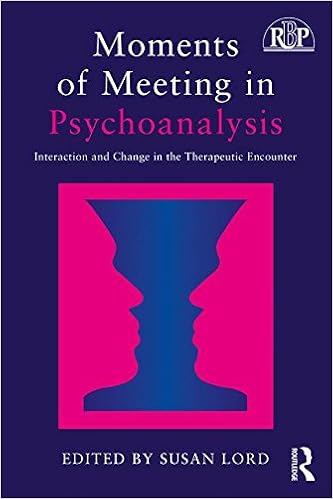
There are moments of connection between analysts and patients during any therapeutic encounter upon which the therapy can turn. Moments of Meeting in Psychoanalysis explores how analysts and therapists can experience these moments of meeting; shows how this interaction can become an enlivening and creative process; and seeks to recognise how it can change both the analyst and patient in profound and fundamental ways.
The theory and practice of contemporary psychoanalysis and psychoanalytic psychotherapy has reached an exciting new moment of generous and generative interaction. As psychoanalysts become more intersubjective and relational in their work, it becomes increasingly critical that they develop approaches that have the capacity to harness and understand powerful moments of meeting, capable of propelling change through the therapeutic relationship. Often these are surprising human moments in which both client and clinician are moved and transformed. Moments of Meeting in Psychoanalysis offers a window into the ways in which some of today’s practitioners think about, encourage, and work with these moments of meeting in their practices. Each chapter of the book offers theoretical material, case examples, and a discussion of various therapists’ reflections on and experiences with these moments of meeting.
With contributions from relational psychoanalysts, psychotherapists and Jungian analysts, and covering essential topics such as shame, impasse, mindfulness, and group work, this book provides new theoretical thinking and practical clinical guidance on how best to work with moments of meeting in any relationally oriented therapeutic practice. Moments of Meeting in Psychoanalysis will be of great interest to psychoanalysts, psychoanalytic psychotherapists, psychologists, social workers, workers in other mental health fields, graduate students, and anyone interested in change processes.
Sunday, June 4, 2017
Forthcoming Teaching and Speaking Schedule June 2017- April 2018 for Mark Winborn, PhD, NCPsyA
June 11, 2017: Moscow
Association for Analytical Psychology, Moscow, Russia
Sept 1-3, 2017: Centro
Jung, Santo Domingo, Dominican Republic
Sept 23-24, 2017: Memphis-Atlanta
Jungian Seminar, Memphis, Tennessee
Oct 14-15, 2017: Minneapolis
Jung Association, Minneapolis, Minnesota
Nov 3-5, 2017: Case Colloquia, Philadelphia
Assoc. of Jungian Analysts, Philadelphia, Pennsylvania
Nov 17, 2017: American Board for Accreditation
in Psychoanalysis, New York, New York
Dec 1-2, 2017: Jung Association of Central
Ohio, Columbus, Ohio
Jan 26-28, 2018: Case Colloquia, Philadelphia
Assoc. of Jungian Analysts, Philadelphia, Pennsylvania
Feb 11-18, 2018: C.G. Jung Institute, Zurich/Küsnacht,
Switzerland
Mar 2-4, 2018: Case
Colloquia, Philadelphia Assoc. of Jungian Analysts, Philadelphia, Pennsylvania
Apr 16-17, 2018: Case
Colloquia, Philadelphia Assoc. of Jungian Analysts, in Santa Fe, New Mexico
Thursday, May 25, 2017
Analytical Psychology and Science: Adversaries or Allies? by Mark Winborn, PhD, NCPsyA
In Psychological Perspectives, 2016, Vol. 59, #4, pp. 490-508
Conclusion:
Jung (like Freud) saw himself as a scientist and was
constantly incorporating new ideas from other fields such as linguistics,
anthropology, physics, Gnosticism, and alchemy.
In fact, Jung has been referred to as a bricoler - a French word that refers to someone who pieces things
together from a variety of sources. I
believe Jung, if he were alive today, would have embraced the recent findings
from infant observation, neurosciences, attachment research, and trauma
research just as he did with Fordham’s early forays into child analysis. I would challenge us to consider whether we
want to suspend progress in Analytical Psychology, preserving it in the “just
so” state we’ve become comfortable with.
I believe our task as Jungians is to re-evaluate, re-cast,
re-interpret Jung’s ideas in light of knowledge from other fields – just as
Jung did in developing his conceptual framework originally. But we have to be
in dialogue with other fields and have an understanding of their findings in
order for this to occur. I believe we have a responsibility to the scientific
method which shaped and informed Jung’s inquiries; a responsibility to peer
more deeply into the relationship between brain and mind and between soma and
psyche; into the psychological and neurological underpinnings of conscious and
unconscious processes; to seriously evaluate Jung's typological model in light
of current neurological and cognitive sciences; and inform our candidates about
the current theoretical debate occurring between those holding apriori
positions on the nature of archetypal experience and those who now postulate
archetypal experience as emergent
phenomena.
Ultimately, scientific empiricism
can’t study or evaluate all of the elements of Analytical Psychology. Many
elements of our field can’t be sufficiently operationally defined in a manner
that would allow study through the scientific vertex. But there are many
elements of Analytical Psychology which can be examined through a scientific
lens - a process by which we can deepen our confidence in our methods and
theories, gain a deeper understanding of why certain methods work, and
occasionally a casting off or remaking of certain theories or practices which
can’t be supported from a scientific perspective. We can’t afford to cast off
empiricism out of a preference for subjectivism if Analytical Psychology is to
survive another 100 years as something other than a well preserved museum
piece.
Many fields of scientific inquiry
have moved towards the positions advocated by Jung while at the same time
adding many new insights it wasn’t possible for Jung to imagine despite his
incredible breadth of vision. We do have Jungians among us who are engaged with
the scientific community. There are a small cadre of others trying to bring
Analytical Psychology into dialogue with contemporary science, including Mario
Jacoby, George Hogenson, Joseph Cambray, Jean Knox, Margaret Wilkinson, John
Merchant, Robert Romanyshyn, David Rosen, Christian Roesler, and John Haule.
In order for this shift to happen,
some who come from backgrounds in the arts and humanities may need to learn
something about the scientific method including research design, sample size,
types of validity and reliability, as well as some familiarity with statistical
inference. But this is not unlike my own journey - coming from a
scientist-practitioner model of clinical psychology training and needing to
become more intimately familiar with the metaphoric world of myths, fairytales,
art, poetry, literature, and religion.
I hope this paper leaves you with the impression that Analytical
Psychology and science can be and need to be allies rather than adversaries. We
need the findings from contemporary science to help us reflect on what we
experience as analytic practitioners. Science needs us to advocate for the
subjective element in the laboratory. Be we cannot fulfill Jung’s dream of a
Analytical Psychology as a mediatory science unless we are in an ongoing
dialogue with the scientific community. In closing, I leave the reader with this thought
from Carl Jung (1976, para. 1236) “Ultimate truth, if
there be such a thing, demands the concert of many voices.”
Saturday, March 18, 2017
Forthcoming 2018: Interpretation in Jungian Analysis: Art and Technique

Subscribe to:
Posts (Atom)